
Lubbock County is taking a practical approach to improving its road network: using existing equipment and county crews to explore cement stabilization as part of its road repair and resurfacing program. An initial project on County Road 7700 provided valuable construction experience—and came in well below the county’s original cost estimate.
The Cement Council of Texas joined county roadway engineers and personnel at the project to observe the work and discuss how the process could support future road improvements.
Bringing an Existing Resource Back into Service
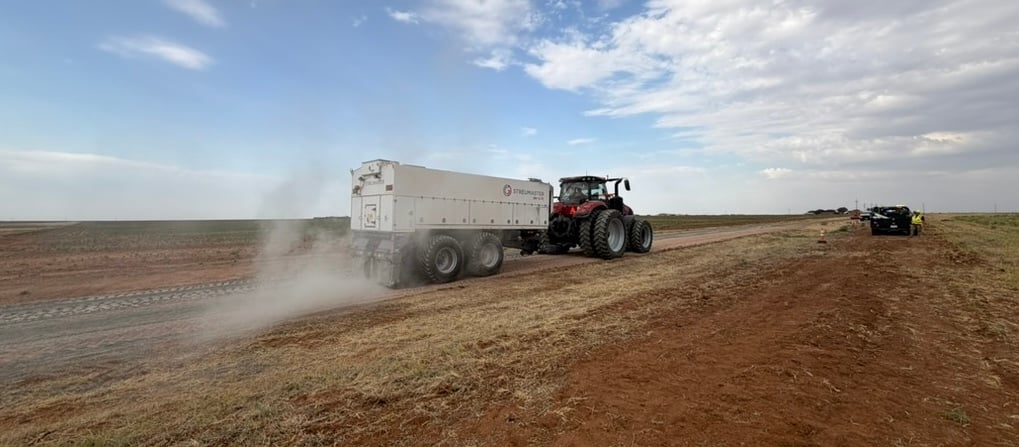
Lubbock County had wanted to use cement stabilization for several years, but limited access to bulk cement prevented the county from moving forward. Its cement spreading trailer had remained unused for so long that it was scheduled for auction.
That changed when Quikrete stepped in to supply bulk cement. With a source of material secured, the county removed the trailer from the auction and began planning a small trial project on CR 7700, approximately half a mile from FM 179.
The project gave the county an opportunity to put its equipment to work, train its crews, and evaluate the process before expanding to additional roads.


Learning in the Field
Following a day of intense West Texas heat, cooler temperatures and overcast skies offered welcome relief for the crew.
A county-owned reclaimer pulverized the existing roadway, while bulk cement was loaded into the spreading trailer. The crew then used water trucks and the reclaimer to mix the material near its optimum moisture content, creating a cement-treated base.
As with many first projects, the work came with challenges. The spreading trailer needed calibration after years of inactivity, resulting in cement application rates that varied across the project rather than consistently meeting the 5 percent target. Water truck issues also required adjustments in the field.
Working through those challenges gave the crew useful experience and identified equipment improvements needed for future projects.
Early Observations and Lessons Learned
In the weeks following construction, county personnel made informal observations of the treated base using pocketknives and a hammer. They reported a hard, cohesive material, including in the portion of the project that received less than the target cement content.
Some small areas of cracking appeared where cement application exceeded the target. County personnel reported that those areas remained cohesive and planned to address the cracks with sealant.
These early observations offered encouraging feedback while reinforcing the importance of equipment calibration and consistent cement application. Continued monitoring will help the county evaluate the road’s performance over time.
Costs Below the Original Estimate
The county initially estimated that the work would cost approximately $300,000 per mile. After reviewing actual project costs, the county reported a figure closer to $100,000 per mile, including asphalt seal coat surfacing.
County officials expect that additional crew experience and equipment refinements could reduce costs further.
For road administrators working to make the most of taxpayer dollars, the initial project offers a promising basis for considering cement stabilization within the county’s broader maintenance program.
Planning for Additional Roads
Lubbock County plans to cement-treat approximately 31 miles of roadway in the coming years.
In more populated areas, the county is considering contractors that can deliver cement slurry using concrete trucks with specialized discharge attachments. This approach would help address dust concerns associated with spreading dry cement.
The county also intends to explore rebuilding roads containing reclaimed asphalt pavement, or RAP, supplied by the Texas Department of Transportation. Incorporating existing roadway materials is another part of its effort to make effective use of available resources.
Connecting Training with Field Experience
Before the site visit, the Cement Council of Texas coordinated a complimentary workshop for Lubbock County personnel and area consultants. Sessions covered soil-cement and cement-treated bases, long-life concrete pavement design, joint performance, paving innovations, and pavement maintenance and rehabilitation.
The workshop and field project connected technical instruction with practical construction experience, giving county personnel an opportunity to discuss methods and see them applied on a local roadway.